Choosing between car shampooing and steam cleaning can be confusing because both methods are used for interior detailing. They are not actually the same process, and neither is always better.
The right choice depends on the material, type of contamination, amount of moisture involved, and condition of the vehicle. Shampooing with extraction is generally better for deeply soiled carpets and fabric upholstery, while controlled steam is useful for low-moisture cleaning of suitable hard surfaces, seams, vents, and other difficult areas.
For many professional interior details, the best approach is to use both methods where appropriate.
Car Shampooing vs. Steam Cleaning: Quick Answer
Car shampooing is generally more suitable for deeply embedded dirt, stains, spills, and heavily soiled fabric because cleaning solution, agitation, and extraction can remove contamination from upholstery and carpet fibres. Steam cleaning uses much less moisture and is useful for suitable hard surfaces, crevices, and selected upholstery. Professionals may combine both.
What Is Car Shampooing?
Car shampooing is a wet-cleaning method used mainly on fabric seats, carpets, floor mats, and other suitable upholstery.
Professional detailing should involve more than simply applying soap to a seat. A proper process usually includes:
- Inspection of the material and contamination.
- Thorough vacuuming.
- Pre-treatment of stains and heavily soiled areas.
- Agitation with appropriate brushes or tools.
- Application of a suitable upholstery or carpet cleaning solution.
- Extraction using an upholstery or carpet extractor.
- Controlled drying and ventilation.
- Final inspection.
The extraction stage is particularly important. It helps remove loosened dirt, cleaning solution, body oils, food residue, mud, and other contamination from the fabric.
Shampooing is therefore useful when a vehicle has dirty carpets, stained cloth seats, winter salt residue, drink spills, or heavily contaminated floor mats.
What Is Steam Cleaning?
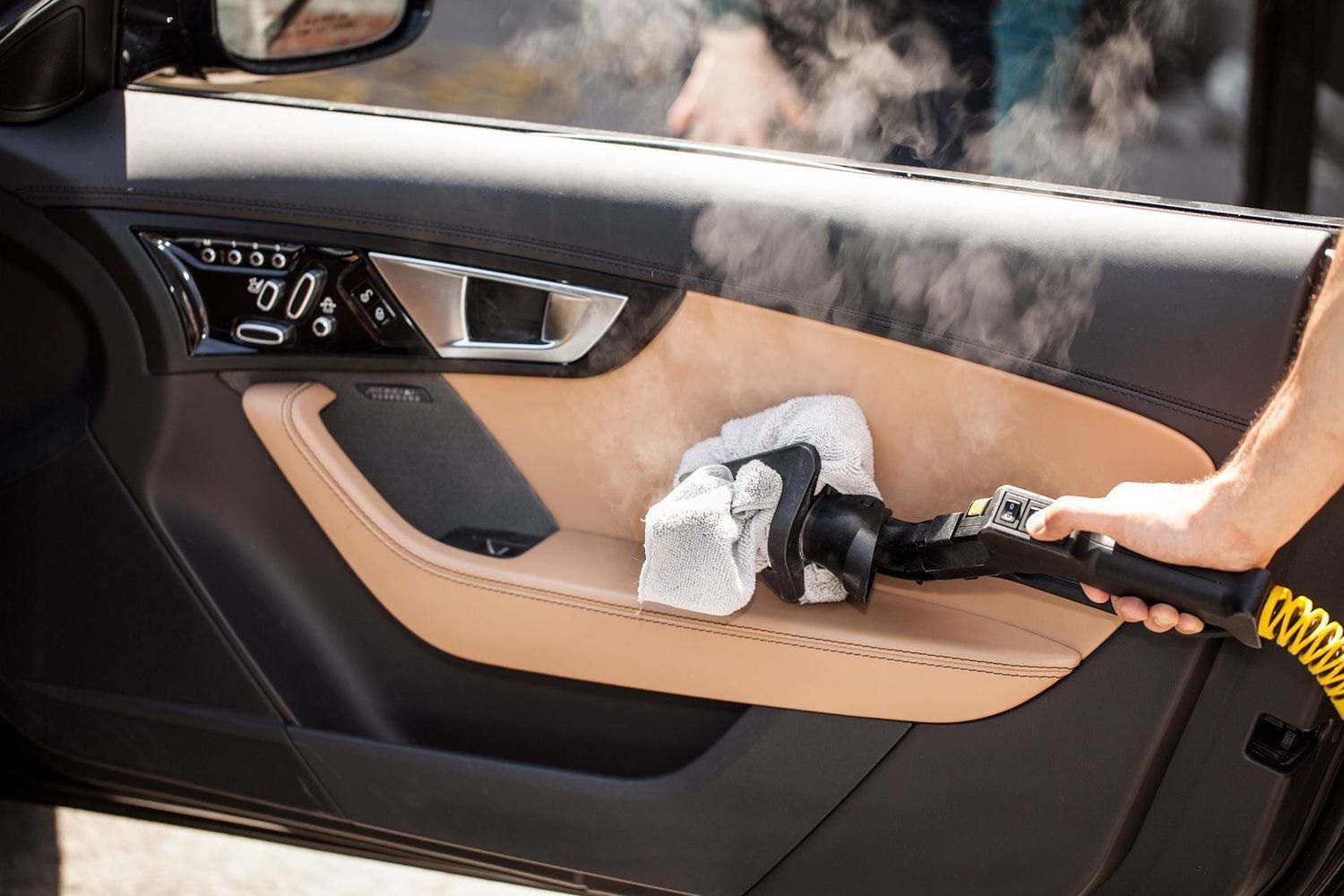
Steam cleaning uses heated water vapour to loosen dirt and contamination while limiting the amount of liquid introduced to the surface.
A professional steam-cleaning process normally starts with inspection and vacuuming. Controlled steam is then applied to appropriate surfaces, followed by wiping with microfiber towels and additional cleaning or extraction when required.
Steam can be particularly useful for:
- Dashboard and plastic trim
- Door panels
- Centre consoles
- Cup holders
- Air vents
- Seams and crevices
- Selected fabric surfaces
- Areas where low moisture is preferred
Steam is not automatically safe for every part of a vehicle. Leather finishes, delicate fabrics, headliners, electronics, screens, and other sensitive components require the correct technique and temperature.
Car Shampooing vs. Steam Cleaning: Key Differences
| Factor | Car Shampooing | Steam Cleaning |
| Moisture | Higher | Lower |
| Deep fabric soil | Very suitable | More limited |
| Carpet cleaning | Strong option | Useful for surface/detail work |
| Cloth seats | Suitable when heavily soiled | Depends on material |
| Hard surfaces | Useful but not always necessary | Very useful |
| Vents and crevices | Limited | Useful |
| Stain treatment | Strong with pre-treatment and extraction | Can loosen some stains |
| Drying | Usually requires more drying time | Generally uses less moisture |
| Winter salt | Strong with appropriate extraction | Useful for targeted cleaning |
| Leather | Requires leather-safe products | Requires careful, material-specific use |
The important point is that these methods solve different cleaning problems.
Which Method Is Better for Different Car Surfaces?
Car Carpets and Floor Mats
For heavily soiled carpets and floor mats, shampooing followed by extraction is usually the more appropriate approach.
Carpet fibres can hold road grime, mud, food particles, body oils, and winter salt. A controlled cleaning solution can loosen this contamination, while extraction removes the loosened material and excess moisture.
Steam can still be useful for targeted areas, but it does not automatically replace extraction.
Cloth Seats
For heavily stained or dirty cloth seats, shampooing and extraction can provide a deeper cleaning process.
Steam may complement the work when the upholstery safely tolerates heat and moisture. The condition of the fabric should always be checked first.
Dashboard, Doors and Plastic Trim
Controlled steam is often useful for hard interior surfaces.
It can help loosen grime around buttons, seams, cup holders, vents, and other difficult areas while using relatively little moisture. Microfiber towels can then remove the loosened contamination.
Leather Seats
Leather should not be treated like fabric upholstery.
The correct approach depends on the type and condition of the leather and its finish. A leather-safe cleaner and suitable tools are generally more important than simply choosing steam or shampoo.
Headliners
Headliners require extra care because excessive moisture can affect the adhesive or cause sagging.
A professional should avoid saturating the material. Gentle, controlled cleaning is preferable to aggressive shampooing or excessive steam.
When Should You Choose Car Shampooing?
Shampooing and extraction are worth considering when your main problem is deep contamination inside fabric or carpet.
It can be particularly useful for:
- Coffee and drink spills
- Food stains
- Mud
- Body oils
- Dirty carpets
- Winter salt residue
- Heavily soiled floor mats
- Fabric seats with embedded dirt
- Long-neglected interiors
For example, a vehicle used daily around Mississauga during winter may accumulate road salt and slush in carpets and floor mats. A deeper wet-cleaning and extraction process can be more appropriate than relying on surface steam alone.
When Should You Choose Steam Cleaning?
Steam is particularly useful when you want controlled, low-moisture cleaning of suitable interior surfaces.
It can make sense for:
- Dashboard grime
- Door panels
- Cup holders
- Vents
- Seams
- Plastic trim
- Light surface contamination
- Areas where excessive moisture is undesirable
It can also be useful as part of a larger interior detailing process.
When Should You Use Both?
This is where the comparison becomes more practical.
Professional detailing does not always require choosing one method. A vehicle can have different surfaces and different types of contamination at the same time.
For example:
Dirty carpet: shampoo and extraction
Dashboard: controlled steam
Vents: controlled steam
Cloth seats: shampoo and extraction when heavily soiled
Leather: leather-safe cleaning
Headliner: gentle low-moisture treatment
Pet hair: mechanical removal followed by suitable cleaning
Odour: source cleaning rather than simply masking the smell
This combination-based approach explains why many professional detailing services offer steam and shampoo together.
Steam vs. Shampoo for Common Car Problems
Stains
Shampooing with suitable pre-treatment and extraction is generally better for deeply embedded fabric stains. Results still depend on the age, type, and previous treatment of the stain.
Pet Hair
Neither steam nor shampoo alone is a complete pet-hair removal solution.
Loose and embedded hair usually requires mechanical removal, followed by cleaning of the affected upholstery and carpet.
Odours
Odour removal starts with identifying and cleaning the source.
Pet urine, spilled drinks, food, smoke, and mildew-like smells can require different treatments. Simply adding fragrance does not remove the contamination causing the odour.
Winter Salt
Winter salt and slush can become trapped in carpets and mats. A suitable cleaning solution followed by extraction can help remove dissolved residue and contamination.
Drying Time
Shampooing generally introduces more moisture, so drying and ventilation become more important.
Steam uses less liquid, but “less moisture” does not mean every surface instantly becomes dry. Drying depends on the material, cleaning process, temperature, ventilation, and amount of contamination.
Common Mistakes to Avoid
One common mistake is assuming that steam can replace every other interior-cleaning method.
Another is treating shampooing as simply spraying soap onto seats. Professional fabric cleaning should involve appropriate pre-treatment, agitation, extraction, and controlled drying.
Avoid these mistakes:
- Saturating seats or carpets unnecessarily
- Using household chemicals on automotive materials
- Applying excessive heat to sensitive surfaces
- Steaming electronics directly
- Over-wetting headliners
- Using unsuitable products on leather
- Ignoring colourfastness or material condition
- Masking odours instead of addressing their source
- Assuming every stain can be completely removed
If you want more information about complete interior care, read our guide car interior detailing Mississauga.
How Much Does Interior Detailing Cost in Mississauga?
Interior detailing prices vary according to vehicle size, condition, service scope, contamination, and the methods required.
For example, Spot Free Auto Spa lists $150 for Interior Steam Clean and $180 for Interior Steam & Shampoo. These are service prices from one Mississauga provider, not a universal market average.
Additional treatments such as pet-hair removal or odour removal can affect the final price.
When comparing providers, ask what is included. A lower advertised price may represent basic interior cleaning, while a more intensive package may include extraction, stain treatment, steam cleaning, drying, and additional problem-specific services.
How to Choose the Right Interior Cleaning Service in Mississauga
Look for a provider that evaluates the vehicle before deciding which method to use.
A good service should consider:
- Fabric, leather, vinyl, and plastic surfaces
- Type and severity of contamination
- Stain condition
- Moisture requirements
- Appropriate equipment
- Extraction capability
- Drying and ventilation
- Pet hair and odour issues
- Sensitive areas such as headliners and electronics
Whether you are near Port Credit, Streetsville, Meadowvale, Erin Mills, Clarkson, Square One, or travelling through the QEW, Highway 401, or Highway 403, the method should be selected based on the vehicle rather than simply choosing the most expensive package.
Final Thoughts
Car shampooing and steam cleaning are not competing techniques in every situation. They are tools for different cleaning requirements.
If your car has heavily soiled carpets, stained cloth seats, spills, mud, or winter salt, shampooing with extraction can be the better choice. For dashboards, vents, hard surfaces, seams, and suitable areas where low moisture is helpful, controlled steam can be highly useful.
For a neglected interior with several different problems, combining both methods may provide the most practical approach.
The best decision is therefore simple: look at the surface and the contamination first, then choose the cleaning method.
FAQs
Is steam cleaning better than shampooing a car?
Neither is universally better. Shampooing with extraction is generally better for deeply soiled fabric and carpets, while controlled steam is useful for low-moisture cleaning of suitable hard surfaces, seams, vents, and other areas.
Is shampooing better for cloth car seats?
For heavily stained or soiled cloth seats, shampooing followed by extraction is often more appropriate because it can help remove contamination from the fabric. Steam may complement the process when the material safely tolerates it.
Does steam cleaning remove stains from car seats?
Steam can loosen some surface contamination and stains, but it does not guarantee complete stain removal. Results depend on the stain type, age, fabric, previous treatments, and cleaning method.
Can steam cleaning damage a car interior?
It can if used incorrectly. Excessive heat or moisture may be unsuitable for some materials, electronics, leather finishes, or headliners. Professional steam cleaning should use controlled application appropriate to each surface.
Does car shampooing make seats wet?
Shampooing uses more moisture than steam cleaning, but professional extraction removes much of the cleaning solution and loosened contamination. Drying time varies according to the material, process, ventilation, and amount of moisture used.
Can steam replace shampooing?
Sometimes, but not universally. Steam can be useful for suitable hard surfaces and certain light-cleaning applications, while heavily contaminated carpets and upholstery may require cleaning solution, agitation, and extraction.
Can you use steam and shampoo together?
Yes. Professional interior detailing can use controlled steam for appropriate hard surfaces and difficult areas while using shampoo and extraction for heavily soiled carpets or fabric upholstery.
What is better for winter salt in a car?
For salt residue embedded in carpets and floor mats, an appropriate wet-cleaning process followed by extraction can be effective. Steam may be useful for targeted areas, but the method should match the contamination and material.
What is better for pet hair in a car?
Pet hair usually needs mechanical removal first. Steam or shampoo alone is not a complete pet-hair removal method. After the hair is removed, suitable upholstery and carpet cleaning can address remaining dirt and odour.
How much does interior car detailing cost in Mississauga?
Pricing depends on vehicle size, interior condition, and services included. Spot Free Auto Spa currently lists Interior Steam Clean at $150 and Interior Steam & Shampoo at $180, while other Mississauga providers use different packages and pricing.